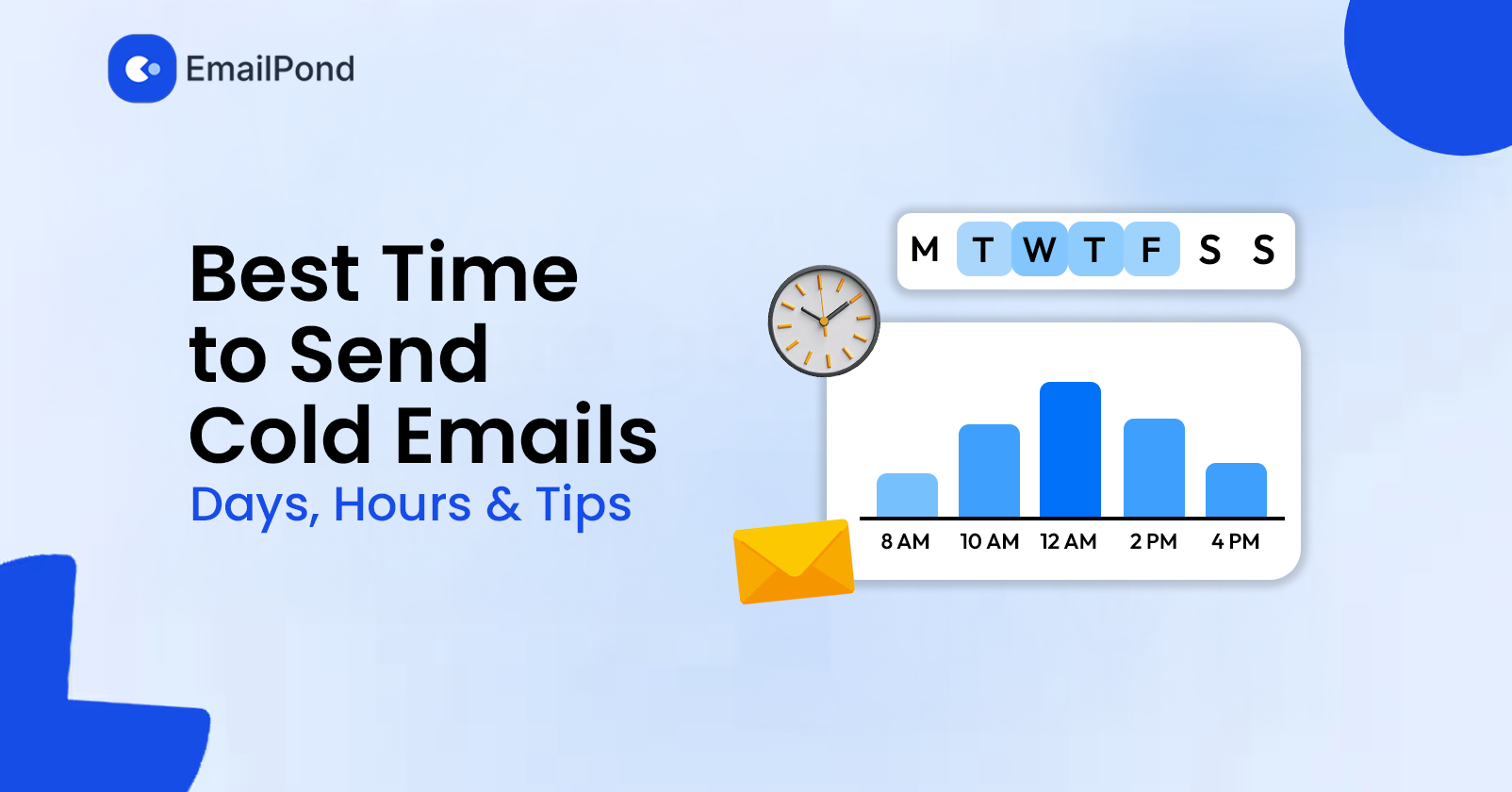
Timing can influence how quickly a cold email gets noticed, but there is no single hour or day that guarantees better results for every campaign. The best sending time depends on the recipient’s location, industry, work schedule, audience, offer, and the quality of the email itself.
For most B2B cold email campaigns, it makes sense to start by testing weekday mornings and early afternoons in the recipient’s local time. From there, use your own campaign data to identify when your audience is most responsive. Good timing can help your message arrive when prospects are available to read it, but strong targeting, relevant messaging, sender reputation, and deliverability remain equally important.
Why Does Cold Email Timing Matter?
People receive emails throughout the day, and a prospect's inbox can become crowded quickly. If your message arrives during a busy meeting, outside working hours, or alongside dozens of other emails, it may receive less attention.
Sending at an appropriate time increases the chance that your email appears when the recipient is actively checking their inbox. This can make your message easier to notice before it gets pushed down by newer emails.
However, timing should not be treated as a replacement for good email strategy. A highly relevant email sent at an average time can perform better than a poorly targeted email sent at the so-called "perfect" hour.
Your campaign should therefore consider timing as one part of a larger system that includes:
Accurate prospect data
Relevant targeting
Strong subject lines
Personalized messaging
Clear offers
Proper sending infrastructure
Good sender reputation
Email authentication
Reasonable sending volume
Follow-up timing
Continuous testing
What Is the Best Day to Send Cold Emails?
For many B2B campaigns, Tuesday, Wednesday, and Thursday are useful starting points for testing. These days generally fall in the middle of the working week, when business recipients are actively handling their normal workload.
Monday can be challenging because people often return to a crowded inbox after the weekend and may prioritize internal tasks, meetings, and planning.
Friday can also behave differently because some prospects finish their weekly priorities earlier, take time off, or spend less time evaluating new business opportunities.
That does not mean Monday or Friday should automatically be excluded. Different audiences can have different schedules. A campaign targeting freelancers, agencies, sales teams, healthcare professionals, restaurants, or e-commerce businesses may have completely different engagement patterns.
Tuesday
Tuesday is often a useful day to test because recipients have moved beyond the start-of-week workload while still being fully engaged with their weekly responsibilities.
For B2B campaigns, Tuesday can be tested during normal business hours, particularly in the morning.
Wednesday
Wednesday provides another strong testing opportunity because it sits in the middle of the standard business week.
Recipients are generally already in their weekly workflow, making it a practical day for prospecting emails.
Thursday
Thursday can also work well for B2B outreach. Prospects may still be actively evaluating projects and responding to business communication before the end of the week.
However, response behavior can vary depending on the industry and the type of offer.
Monday
Monday is not necessarily a bad day, but inbox competition can be high.
Many professionals begin the week by:
Reviewing weekend messages
Attending meetings
Planning weekly priorities
Responding to existing customers
Handling internal tasks
If you send on Monday, testing different times can help determine whether your audience responds better in the morning or later in the day.
Friday
Friday deserves testing rather than an automatic rejection.
Some B2B prospects have lighter schedules or use Friday to clear their inbox. Others may be focused on finishing the week and may have little interest in new opportunities.
The results can therefore differ significantly between industries.
What Is the Best Time to Send Cold Emails?
A practical starting point for B2B cold email is usually during the recipient's normal working hours, particularly:
Around 8:00–10:00 a.m.
Around 10:00–11:30 a.m.
Around 1:00–3:00 p.m.
These are testing windows rather than universal rules.
The most important detail is to schedule emails according to the recipient's local time, not the sender's time zone.
For example, if your sales team is based in Pakistan but your prospects are in the United States, scheduling every email according to Pakistan Standard Time can cause messages to arrive at inconvenient hours for the recipients.
Instead, segment your prospects by location and schedule each group accordingly.
What Is the Best Time to Send Cold Emails by Industry?
Different industries have different work patterns, so timing should be adapted to the audience.
SaaS and Technology
Technology professionals may have flexible schedules and may work across different time zones. Morning and early-afternoon business hours can provide useful starting points.
Marketing Agencies
Agency professionals often move between client work, meetings, and internal tasks. Testing both morning and early-afternoon windows can reveal when your particular audience is most responsive.
Professional Services
Consultants, accountants, lawyers, and similar professionals may have meeting-heavy schedules. Avoiding known busy periods may be more useful than relying on a universal sending time.
E-commerce
E-commerce teams can have different schedules depending on operations, campaigns, customer service, and sales activity. Test timing around the actual working patterns of your target contacts.
Sales Teams
Sales professionals frequently monitor email throughout the day, but their schedules can also be meeting-heavy. Multiple time windows should be tested rather than assuming one fixed hour.
What Is the Best Day and Time for Cold Emails?
Instead of looking for one perfect combination, start with a small testing framework.
Day | Suggested Testing Window |
Monday | 9:00–11:00 a.m. |
Tuesday | 8:00–10:30 a.m. |
Wednesday | 8:00–10:30 a.m. |
Thursday | 9:00–11:00 a.m. |
Friday | 9:00–11:00 a.m. |
You can also test an afternoon window such as 1:00–3:00 p.m. on selected days.
These are starting points, not guaranteed performance benchmarks. Your own campaign data should determine which windows deserve more volume.
How Does Email Timing Affect Open Rates?
Timing can influence whether someone notices an email, but an open rate alone does not tell you whether a campaign is successful.
Modern email measurement also has limitations because privacy features and mailbox technologies can affect open tracking.
Instead of relying exclusively on opens, evaluate multiple signals, such as:
Positive replies
Qualified conversations
Meetings booked
Opportunities created
Conversion rates
Unsubscribe rates
Bounce rates
Spam complaints
For cold outreach, meaningful replies and business outcomes are generally more useful than optimizing for opens alone.
How Does Timing Affect Reply Rates?
Timing can affect when a prospect sees your message, but the content of the email usually determines whether the recipient has a reason to respond.
Consider two emails:
Email A:
"Hi, we offer innovative solutions for businesses. Would you like to learn more?"
Email B:
"Hi Sarah, I noticed your team recently expanded its outbound sales operation. We help agencies manage large-scale cold email campaigns without putting all sending activity on one shared infrastructure."
Even if both emails arrive at the same time, Email B gives the recipient a more specific reason to consider replying.
This is why timing should support relevance rather than compensate for weak messaging.
How Should You Schedule Cold Email Follow-Ups?
The first email is only one part of a cold email sequence.
If someone does not respond, your follow-up should not necessarily arrive immediately. Give the prospect enough time to notice and consider the original message.
A simple sequence might look like:
Day 1: Initial email
Day 3: First follow-up
Day 7: Second follow-up
Day 12: Final follow-up
The exact spacing should depend on your audience, offer, campaign length, and sending strategy.
Follow-ups should also provide additional context rather than simply repeating the same message.
For example, the second email could introduce a different benefit, answer a likely objection, or provide a concise example of the problem you solve.
How Can You Run a Cold Email Timing Test?
A simple testing process can help identify useful sending windows.
Step 1: Define Your Audience
Start by identifying:
Industry
Job role
Company size
Geographic region
Time zone
Business model
The more clearly you understand your audience, the easier it becomes to interpret timing data.
Step 2: Choose Several Time Windows
Select two or three reasonable windows.
For example:
8:30–9:30 a.m.
10:30–11:30 a.m.
1:30–2:30 p.m.
Avoid testing too many variables simultaneously.
Step 3: Split Similar Audiences
Create reasonably comparable segments.
If one group contains senior executives and another contains junior employees, differences in performance may be caused by audience composition rather than timing.
Step 4: Keep the Messaging Consistent
Use substantially similar messaging during the initial timing test.
If you change the subject line, offer, audience, and sending time at once, you will have difficulty determining what caused the difference.
Step 5: Measure Meaningful Results
Track:
Delivery rate
Bounce rate
Positive reply rate
Negative reply rate
Meeting rate
Conversion rate
Unsubscribe rate
Spam complaints
Do not automatically declare a winner based only on opens.
Step 6: Repeat the Test
A single campaign can contain unusual results.
Run the test across enough comparable sends to identify a consistent pattern. Then continue monitoring performance because audience behavior can change over time.
What Other Factors Matter More Than Timing?
Timing is important, but several other factors can have an even larger impact on cold email performance.
1. List Quality
Sending to inaccurate or outdated contacts can increase bounce rates and reduce campaign quality.
Use reliable data and remove invalid addresses before sending.
2. Targeting
A relevant prospect is more likely to care about your offer than someone selected simply because they match a broad job title.
Define a clear ideal customer profile and build lists around it.
3. Personalization
Personalization should be meaningful rather than simply inserting a first name.
Good personalization connects the message to something relevant about the prospect, company, role, problem, or business situation.
4. Subject Line
A subject line should accurately represent the email without relying on misleading clickbait.
Short, natural subject lines are often easier to understand quickly.
5. Email Copy
Keep the message focused on the prospect.
Avoid long introductions, unnecessary company history, and excessive product descriptions.
6. Offer
The recipient needs a reason to respond.
Your offer should be relevant, understandable, and appropriate for the person receiving the email.
7. Sender Reputation
Your sending reputation can affect whether emails reach the inbox.
Sending practices, engagement, bounce rates, complaints, authentication, domain reputation, and infrastructure can all influence deliverability.
8. Sending Volume
Large-scale cold email campaigns require careful volume management.
Increasing volume too aggressively can create deliverability problems, particularly when domains and mailboxes do not have an established sending history.
How Can You Improve Cold Email Timing for Global Campaigns?
Global campaigns require more planning than campaigns focused on one region.
Instead of creating one universal schedule, divide your database by time zone.
For example:
North America: Schedule around North American working hours.
Europe: Use European local business hours.
Asia-Pacific: Create separate schedules based on each relevant market.
This prevents recipients in one region from receiving messages at inappropriate times simply because another region is active.
What Are Common Cold Email Timing Mistakes?
Sending According to Your Own Time Zone
Your location does not determine when the prospect is available.
Always consider the recipient's local time.
Assuming One "Perfect" Hour
No universal hour works for every industry and audience.
Treat commonly recommended times as starting points.
Ignoring Weekday Differences
Monday, Tuesday, Wednesday, Thursday, and Friday can produce different results.
Test multiple days rather than relying on one assumption.
Sending During Obvious Off-Hours
Messages sent during the middle of the night may wait in the inbox until the following workday.
Changing Too Many Variables
If you change timing, copy, subject line, offer, audience, and sender simultaneously, your results become difficult to interpret.
Focusing Only on Opens
An open does not necessarily mean that the prospect is interested.
Measure replies, meetings, conversions, and other meaningful outcomes.
Ignoring Follow-Up Timing
A strong initial email can still underperform if follow-ups are too frequent, too repetitive, or poorly spaced.
Why Choose EmailPond for Cold Email Warmup and Deliverability?
EmailPond helps businesses prepare and maintain their email accounts for cold outreach by focusing on sender reputation and deliverability. Its warmup system uses a connected network of inboxes to generate natural-looking email activity, including opens, replies, and conversations. It supports Google Workspace and Microsoft 365 through OAuth, helping users warm up multiple inboxes without managing each account manually.
EmailPond is also designed for agencies, sales teams, and marketers managing multiple sending accounts. It offers REST API and webhooks for automation and provides plans that support multiple inboxes without locking core warmup features behind higher tiers. By building sender reputation before and during campaigns, EmailPond can complement a well-planned cold email strategy where factors such as sending time, list quality, targeting, and email content also influence deliverability.
Should every cold email campaign use the same sending schedule?
No, different campaigns can target different industries, job roles, countries, and time zones. A schedule that works for one audience may not produce the same results for another.
Does the prospect's job role affect the best time to send cold emails?
Yes, executives, sales representatives, developers, consultants, and business owners may have very different daily schedules. Consider the typical working patterns of your target role when choosing testing windows.
Does industry affect cold email timing?
Yes, industries often have different working hours and communication patterns. A schedule suitable for a SaaS company may not be appropriate for a restaurant, healthcare business, agency, or construction company.
Is it better to send cold emails at the beginning of the workday?
The beginning of the workday can be a useful testing period because recipients may review their inboxes as they start work. However, some professionals begin their day with meetings and urgent tasks, so later morning or afternoon sending may work better for certain audiences.
Does time zone segmentation improve cold email campaigns?
Time-zone segmentation can make scheduling more relevant for international campaigns. It allows emails to arrive during appropriate local business hours instead of using one sending time for prospects across multiple regions.
What time should I send cold emails to U.S. prospects?
For U.S. B2B prospects, start by testing normal local business hours, such as 8:00–10:30 a.m. or 1:00–3:00 p.m. Because the U.S. spans multiple time zones, campaigns should account for the prospect's specific region.
What time should I send cold emails to European prospects?
Start by testing normal European business hours in the recipient's local time zone. Morning and early-afternoon windows can provide useful starting points, but the best schedule should be determined through campaign testing.
Can sending at the right time improve deliverability?
Timing alone does not guarantee better deliverability. Deliverability is influenced by factors such as sender reputation, authentication, bounce rates, spam complaints, list quality, sending behavior, and infrastructure. Good timing should complement a healthy sending setup.